Give your best people time for AI
Delegating AI adoption to juniors, enthusiasts, or whoever has bandwidth means learning too slowly to stay competitive.
Many organizations are making the same mistake right now. They recognize that AI matters, decide “we should do something with it,” and then assign one or two people to explore it. Juniors. Or an enthusiast. Or someone who happens to be between projects. Let someone figure out what it can do first, then we’ll see.
That sounds reasonable. It is strategically unwise.
The real value of AI lies in seeing more clearly what needs to change — which steps have become redundant, what needs to be built, where competitive advantage emerges. That kind of judgment belongs to the people with the most experience, the most context, and the most responsibility. AI adoption therefore belongs in the center of the organization. With your best people.
The wrong reflex
AI gets treated as a tooling question. Which model do you pick, which licenses do you procure, which chatbot is safe enough for internal use. In that framing, it makes sense to let a few people experiment and bring the rest on board later.
But AI changes how work is distributed, how decisions are prepared, how software is built, and how fast small teams can move. Coding agents accelerate the production layer of software. Generative models accelerate analysis, synthesis, writing, and preparation. Agent workflows make it possible to restructure entire chains of work.
Once that happens, learning speed becomes more important than productivity.
And that is where things go wrong. Organizations assume they can join later. That AI adoption is something you phase in once the tooling stabilizes. But later is precisely the moment when smaller, AI-native teams have already built their lead.
Why your best people, specifically
There is a persistent misconception that AI is mainly interesting for execution work — writing emails faster, summarizing faster, generating code faster. That benefit is real. It is not the most important one.
The greatest value of AI emerges with people who already have strong judgment.
A consultant with fifteen years of experience sees with Claude in two hours what used to take three days of analysis. A software architect uses Cursor to comprehend a legacy codebase that nobody dared to touch anymore — and finds the structural flaw that has been causing production incidents for two years. An operations manager has a coding agent map the entire order-to-delivery chain and discovers that four of the twelve steps are administrative residue that nobody questions anymore.
AI makes such people more productive. More importantly: it expands their reach. What they always saw, they can now validate faster, apply more broadly, and substantiate more concretely.
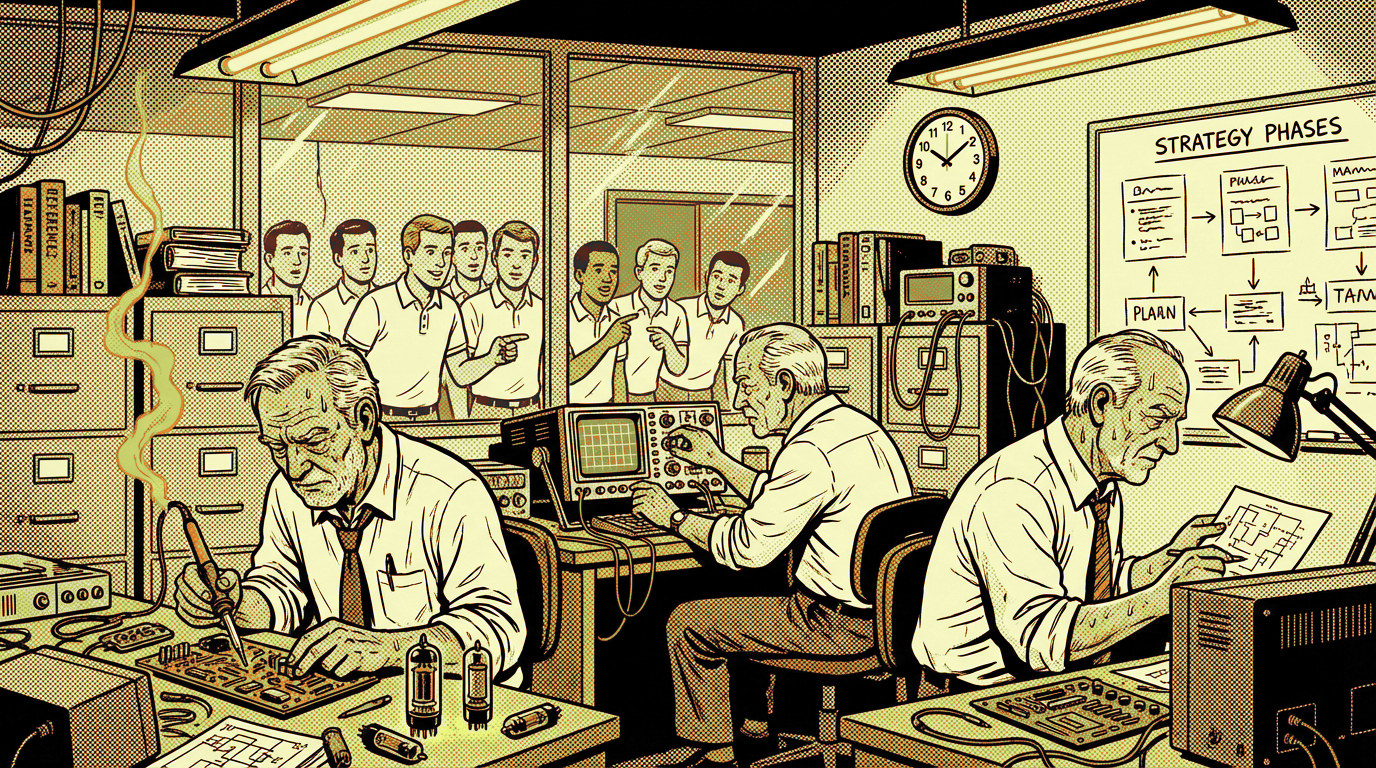
Keeping those people outside this development does not protect them. It lets them slowly age out on a way of working that is shifting beneath their feet.
Time is the real investment here
Every company now says AI is important. Far fewer companies act on it.
The real question is whether an organization is willing to structurally free up time for it. Seriously. As part of the work. With expectations, discipline, and repetition. A consultant at McKinsey who works with Claude three hours a week learns more in a quarter about AI’s impact on her field than an entire innovation team evaluating tools without deploying them in real work.
That is uncomfortable, because the best people are the busiest people. They run projects, make decisions, mentor others, and keep quality high. It feels inefficient to free up their time specifically.
That is the thinking error.
If AI changes how work gets done, those hours are a strategic investment. You are buying learning capacity for the next phase of operations. You are training on a new production layer.
Organizations that understand this gain a different kind of advantage. The organization as a whole learns faster which tasks can be done differently, which processes need to be redesigned, and where new value emerges.
The competition most companies are not watching
Established organizations compare themselves to existing competitors. Parties with the same cost structure, team composition, and decision-making process. AI is changing precisely the bottom of the market.
The real threat comes from the small team that has fully integrated AI from day one. That team has less overhead between idea and execution. It tests more variants per week. It has fewer layers between decision and prototype.
Vic Boomer is itself an example. This studio runs on six AI agents that autonomously write, review, illustrate, and publish essays — with style guides, governance, and quality control built in. Two months ago it did not exist. The startup time for a fully operational editorial studio has dropped from months to days. That is the pace at which AI-native teams move.
By the time a larger organization thinks “now we really need to start moving,” a smaller team has already built hundreds of hours of learning advantage. That advantage is not visible in marketing language. You see it in speed, in sharper iteration, in lower production costs, and in better decisions.
What organizations should do now
The first step is smaller and more serious than an innovation program: designate your strongest people and give them structural time.
People from product, operations, software, commercial, or service delivery — depending on where your core processes sit. A small group with context, judgment, and influence. Give them access to tooling and room to work with it, test cases, compare patterns, and bring findings back.
The second step: make that learning visible as changing ways of working. Which tasks take less time? Which quality standards are shifting? Which roles are changing? Which processes can be done differently? That is where real adoption begins.
The third step: treat AI as part of professional work. With expectations, with discipline, and with repetition.
Not a luxury
Organizations that keep postponing this risk learning too slowly. In a phase where software, knowledge work, and execution are changing shape, learning too slowly is not a minor problem. It is how you lose relevance.
AI adoption belongs in the center of the organization. In the real work. With the people who make the difference. They especially must lead — so that they remain the best.
Vic Boomer is an essay-led AI studio that turns ideas about AI, agents and software into clear analysis, working systems and practical tools.