Creative with AI: experimenting with the Ulam spiral
A mathematical idea from 2009, seventeen years too early, became possible again when AI made the editorial and visual work lighter. That's how kenjemenog.nl came to be.
In 2009 I was thinking about a strange problem.
A normal x-y coordinate system is infinite. You can move left, right, up and down. But how do you give every conceivable position a sequence number? Not just a technical number, but an order that feels visually logical.
I arrived at a spiral.
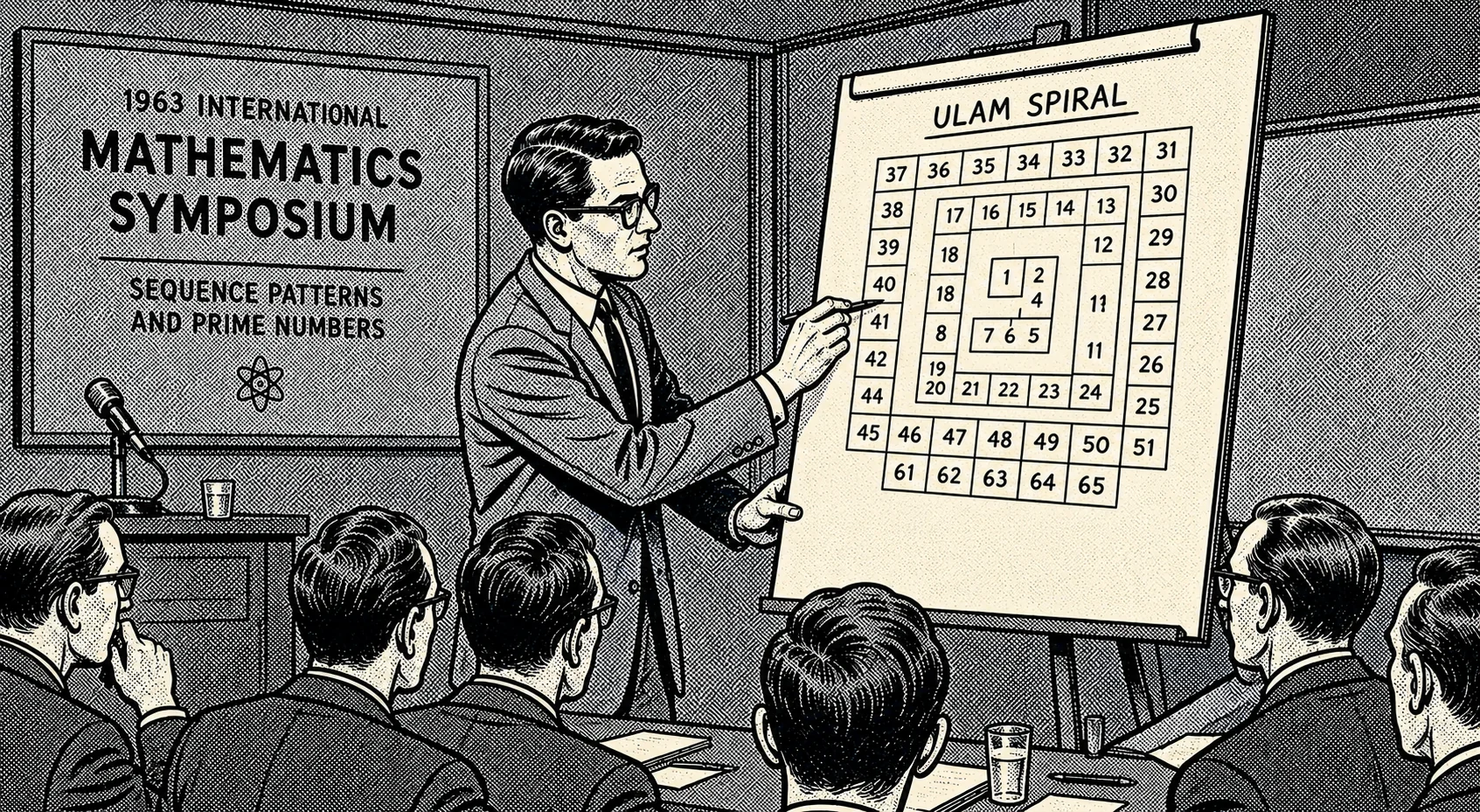
Start in the middle. Place 1 there. One step right for 2. One step up for 3. Then left, down, right, and further outward. Every square on an infinite grid gets its place in a sequence.

I thought it was a rather elegant find. In my head I could already see a patent, maybe even a small digital breakthrough. Meanwhile I now know, thanks to ChatGPT, that my discovery had already been made in 1963 by Stanisław Marcin Ulam. The Ulam spiral became famous because prime numbers form unexpected diagonal patterns in that grid.
I used it for something else.
Not for numbers, but for memories.
A spiral of faces
Back then I wrote a PHP algorithm that could draw such a spiral in HTML. Each square got a position. Each square could hold content. Text, an image, a card, a small object.
The first real application emerged later, after an evening on a café terrace.
A friend asked: “Is that Dutch TV personality actually still alive?”
You get questions like that sometimes. You see someone in front of you. A presenter. An actor. A football player. Someone from a programme you used to watch. You don’t remember exactly when you last saw them. You look it up. And someone turns out to have died years ago.
In that moment I saw the site in front of me.
Not an ordinary list. Not a dry database. Not a chronological timeline.
A field of portraits.
In the middle stands the most recently deceased well-known Dutch person. Around them lie the others, further and further back in time. The spiral begins at now and slowly winds into the past.
You don’t look at dates. You look at faces.
And each time you think: oh yes, that one.
The centre as starting point
What’s special about the spiral is that the middle takes on meaning.
The middle portrait is the starting point: the person from whom the memory field organises itself. That’s why the centre lies larger and on top. The others lie around it like loose photographs, slightly overlapping, as if spread out on a table.
The field is not fixed to one screen. You can drag it in all directions: left, right, up and down. Each time you pull another part of the past towards you.
Click a portrait and a window opens with short information about that person: who was this again, where do I know them from, what era does that evoke?
There you find the most important button: Start from here.
Only when you click it does the perspective change. That person becomes the new centre. The spiral rebuilds itself. Everything more recent falls away. Everything older shifts around the new centre.
Browsing becomes a journey through time. You drag through the field, open memories, and can decide at any moment: from here I’ll look back.
Why the project sat dormant
The idea was technically feasible. Even in 2009.
But the work around it was enormous.
You needed portraits. Names. Dates. Biographies. Source control. Correct sorting. A good interface. A way to pan in all directions. A click-window with information. And above all: design that didn’t feel like an Excel sheet with photos.
I could build the algorithm. I could draw the page. But the editorial work was too much. The site would only work if it was rich, careful and pleasant. Otherwise it would be a gimmick.
So the idea sat.
As many ideas do: not because they’re bad, but because execution required too much manual work at the time.
What AI changed
Now that’s different.
AI can not only write code. AI can also help with the endless fine-tuning of an interface. Not one design, but ten variants. Not one CSS solution, but keep trying until the field feels right. Until the portraits lie like Polaroids. Until panning works naturally. Until the centre genuinely becomes the centre of gravity.
The editorial work has also changed.
Where you used to have to gather, structure and rewrite everything yourself, you can now use AI to make a first layer much faster. Not to trust blindly, but to make the heavy work lighter. Collect names. Check dates. Draft short texts. Normalise information. Place sources side by side.
The human task shifts.
No longer doing everything by hand, but deciding what’s correct, what has taste, what is respectful, and what the site ultimately wants to be.
Not a memorial site
That’s where the most important choice lies.
This project should not become an “in memoriam” site. Not heavy, not solemn, not with black borders and big words.
It’s about recognition.
About that strange moment when you see someone and are immediately back in a particular time. A Saturday evening programme. A theme tune. A voice. A commercial break. A summer of sport. A children’s show. A talk-show table. A generational feeling.
Famous Dutch people are anchors in that respect. Not only because they were famous, but because they appeared in living rooms at fixed moments. They belong to periods in your life.
You grew up with them without knowing them.
And years later you meet them again.
The site that emerged from the experiment
That’s how the experiment ultimately became a website.
A spiral of portraits. A field of memory. A way to travel through familiar faces, not via search bars and categories, but via time, proximity and recognition.
In the middle the present begins. Outward, it becomes the past.
You can scroll, click, reorder and start again. Every choice creates a new centre. Every new ordering reveals another piece of collective memory.
It started as a mathematical problem about coordinates.
It became a visual way to organise memories.
And that’s how kenjemenog.nl came to be.