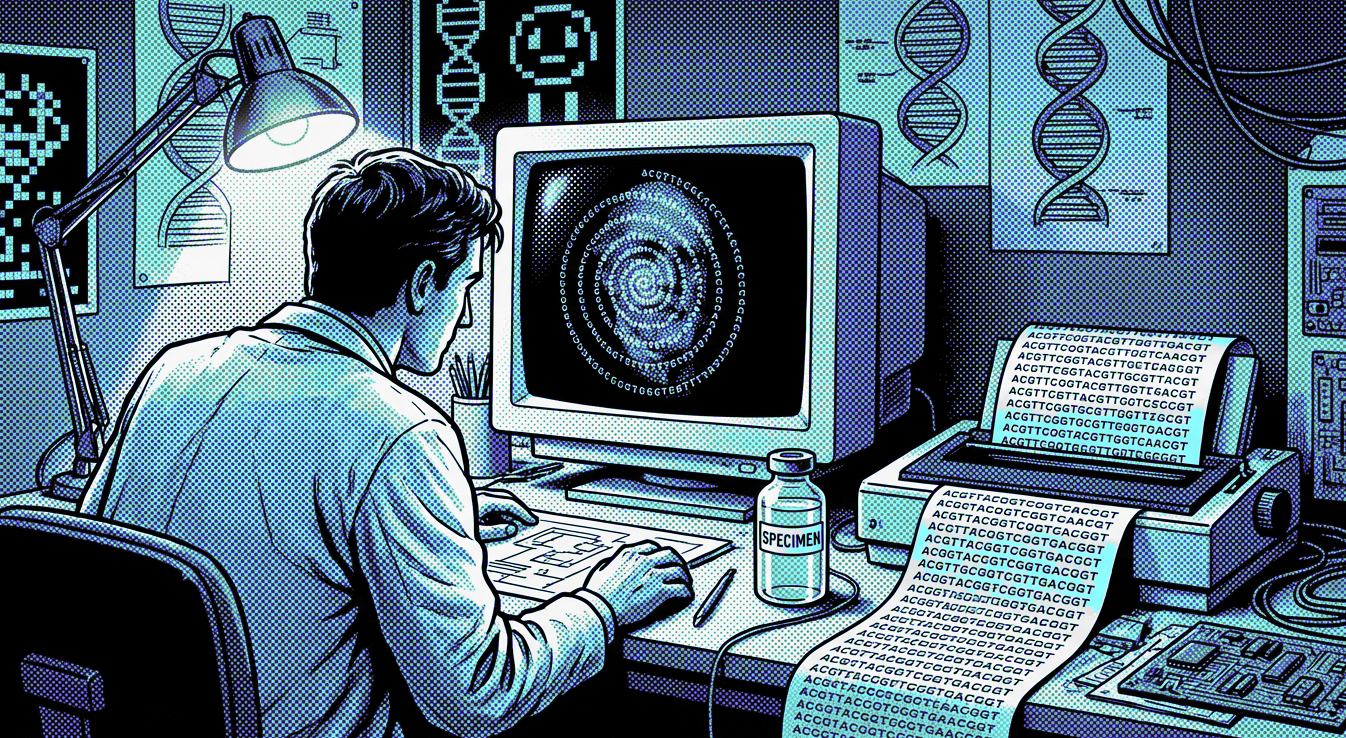
What if a meme could last a million years?
A small Python project takes a digital image and turns it into real DNA. Santa Claus, written in the language of life. Here's how it works, and why it's stranger than it sounds.
A meme lasts about three weeks.
Not because anyone deletes it. The file still sits on a server somewhere. The tweet is still there. The image is in someone’s camera roll. But the meme itself has evaporated, because a meme was never the file. It was the spot that file held in the attention of a few million people, and the attention has moved on.
We are surprisingly bad at preserving our own digital culture. JPEG has existed since 1992. Nobody guarantees it will still be readable a hundred years from now. The servers we trust will eventually be unplugged. The cloud is somebody else’s computer, and that computer has a maintenance contract that will one day run out.
There is, however, one storage medium that genuinely lasts. It has been around for about four billion years and we keep finding it intact in fossils older than any human civilization. It is DNA.
How DNA works, briefly
Inside every cell of your body sits a kind of recipe book. It is written in an alphabet of just four letters:
A C G T
That’s it. Four letters. The whole instruction manual for building a human being is written using nothing else.
The cell reads these letters in groups of three. Each group is called a codon. Things like ATG, GCC, TAA. Four letters, taken three at a time, gives you exactly 64 possible codons. Not approximately 64, exactly 64.
Each codon is an instruction. Most of them tell the cell to attach a specific building block to a growing protein chain. A few are special: ATG means “start building here,” and TAA, TAG and TGA mean “stop, the protein is finished.”
Pixels turn into letters. Letters turn into proteins. Proteins turn into you.
The point is that DNA is code. It is a formal language with letters, words, a beginning and an end. It works almost exactly like the way a computer reads code to run a program. The only difference is what the code produces. A computer program produces pixels on a screen. DNA code produces a living thing.
The flip
dna-spiral-art is a small Python project by Tom Neijman that does something strange. It runs the arrow of biology backwards. Instead of DNA building an image of life, it takes an image and turns it into DNA.
The mechanism is simple. An image is made of pixels. Each pixel has a brightness value between 0 and 255. Six bits of that value, which gives you 64 possible numbers, map directly onto the 64 possible codons in DNA. So a pixel’s brightness becomes a three-letter group: maybe AAA, maybe TGC, maybe GAT.
The clever part is how the project reads the image. It doesn’t go left-to-right, top-to-bottom like a screen. It follows a spiral from the center outward, the same kind of curve you find in seashells, sunflowers and the famous double helix of DNA itself.
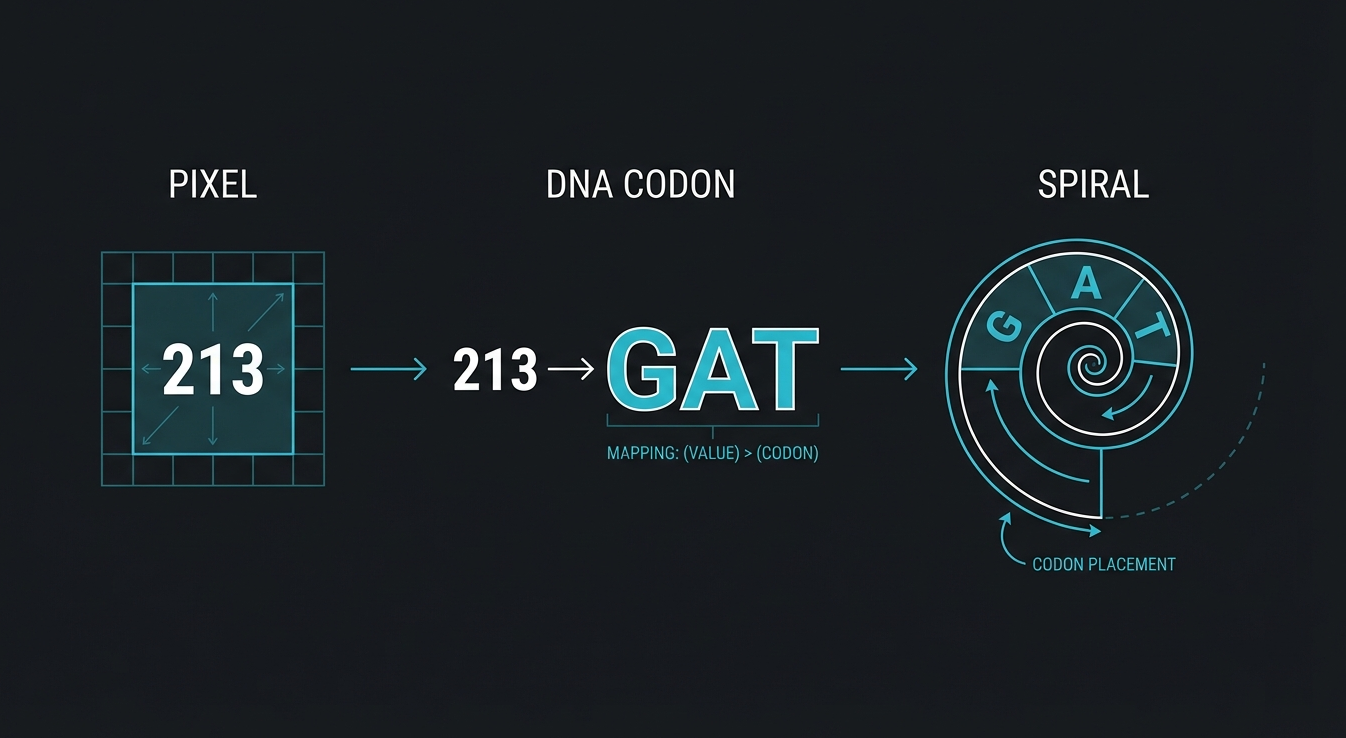
The result is an image made entirely of tiny letters arranged in a spiral. From a distance you see the original picture. Up close you see thousands of A’s, C’s, G’s and T’s.
What it actually produces
In this example, the input image is Kelsey Peters, chief editor at Vic Boomer.
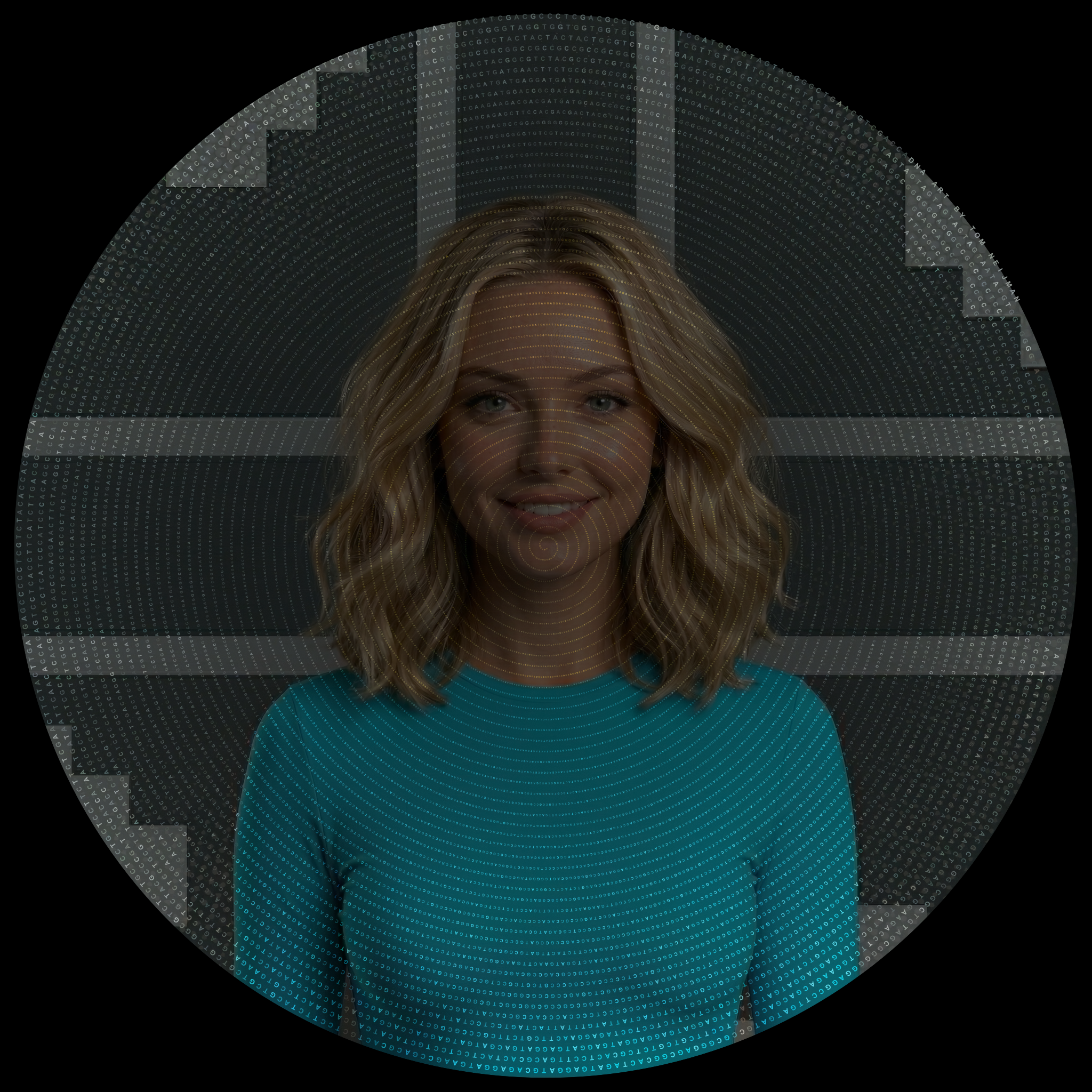
The output sequence is 60,711 base pairs long. The breakdown:
- Adenine: 28.4 percent
- Thymine: 12.5 percent
- Guanine: 24.0 percent
- Cytosine: 35.1 percent
- GC content: 59.1 percent
These numbers aren’t decoration. The GC content sits within the range that commercial DNA synthesis labs accept. The melting temperature (89.1 °C) is consistent with a real double-stranded molecule of that length. The output file is in FASTA format, which is the standard format you send to a synthesis lab.
Loading kelsey_order.txt...
In other words: this isn’t a metaphor. It is a real DNA sequence. You could email it to IDT, Twist Bioscience or GenScript today, pay a few hundred dollars, wait a few weeks, and receive a small tube containing a piece of DNA that, on the molecular level, is the image of Kelsey Peters.
That tube would last, in dry storage, for a very long time. Probably longer than every server that ever held the digital version.
Why this is interesting
The deeper observation hiding in this project is that DNA and computer code aren’t different kinds of things. They are the same kind of thing on different substrates. Both are formal languages. Both have letters and words and grammar. Both can hold information without losing it. The only difference is what executes them: a computer or a cell.
Once you see that, something shifts. The question of how to preserve a digital file stops being about finding a longer-lasting hard drive. It becomes a question of which substrate you want the information to live on. JPEG on a server is a practical choice. So is FASTA in a lab. The information is the same. The medium is a decision.
dna-spiral-art makes that decision tangible. It takes the most fleeting category of digital culture (the meme, the icon, the image that everyone shares for two weeks and then forgets) and writes it in the most durable language we know.
A meme could, in principle, outlive every server that ever held it. The infrastructure to make that happen exists. Someone just has to decide it’s worth doing.
That last part is the open question.